Benefits of Using Ovum Pick-Up (OPU):
Two Perspectives on a Growing Reproductive Tool
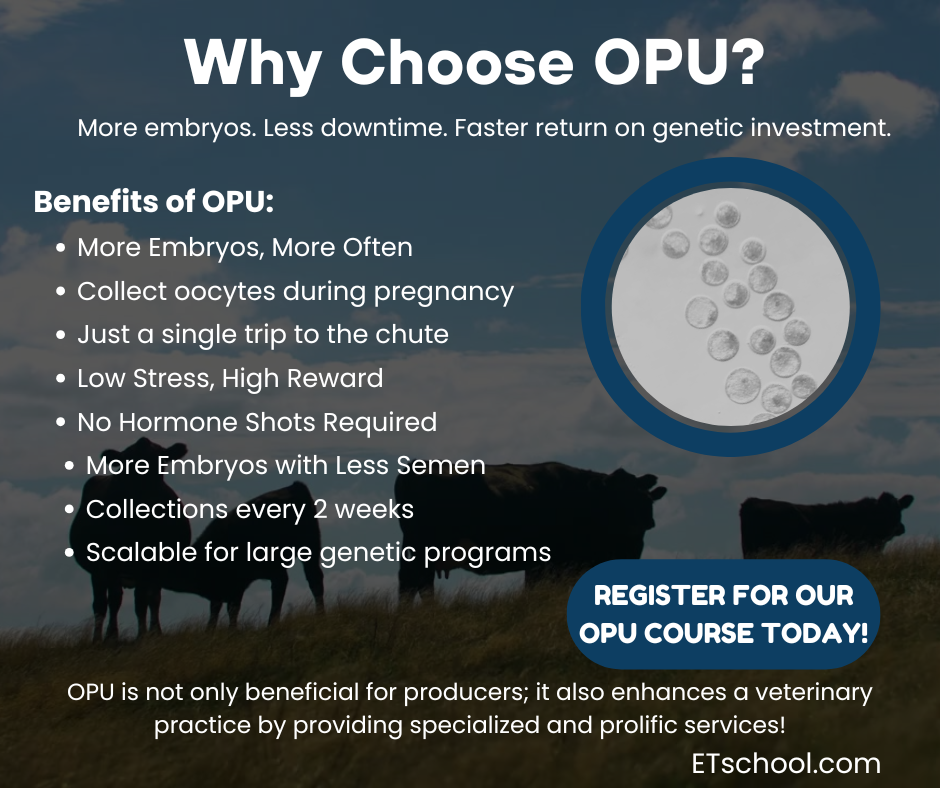
As reproductive technologies continue to advance in the cattle industry, ovum pick-up (OPU) has become one of the most flexible and practical tools available to both producers and veterinarians. Whether you are a seedstock producer looking to multiply elite genetics or a practitioner expanding reproductive services, OPU offers clear advantages.
To understand its value, it helps to look at OPU from two perspectives:.
- The owner of the donor female
- The practitioner adding it to their practice
What Is OPU?
Ovum pick-up is an ultrasound-guided procedure used to collect oocytes (eggs) directly from the ovaries of a donor female. Those eggs are then fertilized in vitro (IVF) in a laboratory and developed into embryos, which are later transferred into recipient females.
Many veterinarians partner with IVF laboratories that handle fertilization and embryo development, while the practitioner performs the on-farm aspiration (collection) procedure.
Unlike traditional superovulation and embryo flush programs, OPU does not require heavy hormone stimulation and can be performed more frequently.
Perspective 1: The Owner of the Donor Female
For the owner of a high-value female, OPU is about two main things: speed and flexibility.
1. Increased Genetic Multiplication
One of the biggest advantages of OPU is the ability to produce embryos quickly, even from females that do not respond well to conventional flush protocols. Some donors simply do not superovulate efficiently. With OPU, eggs can be collected regardless of response to heavy hormone stimulation.
OPU can often be performed every two weeks. In contrast, a traditional flush program typically takes 30–45 days from start to finish and requires a rest period of 40–50 days before repeating.
This means a single elite female can produce significantly more embryos in a shorter period of time.
For seedstock operations, this results in:
- Faster multiplication of elite genetics
- More embryos available for sale or transfer
- Accelerated genetic progress within the herd
For commercial producers retaining ownership, it provides a way to multiply proven maternal cows or high-performing carcass females.
2. Collection from Unique or Hard-to-Manage Donors
OPU offers flexibility when traditional flushing may not be ideal.
Examples include:
- Prepubertal heifers
- Donors in the first 1–3 months of pregnancy
- Donors that have not produced high embryo numbers with conventional flushing
- Donors that are difficult to superovulate
- Show females or animals that travel frequently
Because OPU does not require a full superovulation protocol, it can often be used in females that would otherwise be excluded from embryo programs.
The procedure typically takes 15–20 minutes per female, reducing the time and labor required compared to a full flush protocol.
For owners, this means:
- Access to genetics that might otherwise be unavailable
- Shorter intervals between collections
- Flexibility to schedule around shows, sales, or breeding seasons
3. Reduced Hormone Requirements
Traditional embryo flush programs require follicle stimulating hormone (FSH) injections every 8–12 hours for at least four days. While effective, this approach requires labor, time, and consistent handling.
For some high-value females, especially those with strong temperaments or limited handling facilities, this can be challenging.
OPU requires fewer hormone injections, and in some cases can be performed without extensive pre-treatment, depending on the program design and producer goals. There is no long lead-up protocol, which allows OPU sessions to be scheduled around other important events.
For many producers, this means:
- Less intensive handling
- More flexible scheduling
- Reduced management stress on elite females
4. Strategic Mating Flexibility
Because fertilization occurs in the laboratory (IVF), OPU allows more flexibility in how semen is used.
During a single OPU session, producers can:
- Split eggs across multiple bulls
- Use rare or sexed semen strategically
- Test several mating combinations from one donor
- Use fewer semen straws more efficiently
In conventional in vivo fertilization, one straw typically fertilizes one cow. In IVF, semen is used to fertilize multiple eggs in the lab dish, often allowing higher-value or more expensive semen to be used more efficiently.
This flexibility allows producers to:
- Make strategic breeding decisions
- Maximize the value of elite semen
- Diversify genetics within a single collection
Perspective 2: The Practitioner
From a veterinary perspective, OPU is both a technical skill expansion and a practical way to grow services within your practice.
1. Expanded Service Offerings
Adding OPU allows a practice to move beyond conventional AI and pregnancy diagnosis into advanced reproductive technologies- without dramatically increasing behind-the-scenes management demands.
If your practice already offers:
- Estrus synchronization
- Artificial insemination
- Embryo transfer
OPU integrates naturally into those services.
Unlike designing full superovulation protocols and managing multi-day hormone schedules, OPU sessions are straightforward and efficient. Many practitioners partner with established IVF laboratories that handle fertilization and embryo development, allowing the veterinarian to focus on the collection procedure.
For clinics with strong in-house facilities, OPU can be offered as a scheduled service without the need for extensive travel. It provides flexibility while still generating meaningful return on investment.
In competitive markets, offering OPU positions your practice as a full-service reproductive partner rather than a single-service provider.
2. Increased Client Retention
Producers investing in OPU-IVF programs typically require an established Veterinary Client Patient Relationship (VCPR). That relationship often expands into broader collaboration, including:
- Recipient management
- Synchronization planning
- Pregnancy diagnosis
- Ongoing reproductive strategy
By offering OPU, veterinarians often deepen long-term client relationships. Instead of seasonal reproductive interaction, herd management becomes a year-round conversation.
Producers utilizing IVF and OPU are often progressive, data-driven, and willing to invest in their herds. These are clients focused on long-term genetic improvement and sustainable growth- which naturally strengthens the veterinary-client partnership.
3. Revenue Diversification
OPU creates additional revenue opportunities within the practice, including:
- Collection fees
- Facility or chute fees
- Recipient synchronization programs
- Transfer of IVF embryos
- Genetic and mating consultation
Importantly, this revenue is tied to high-value females and progressive operations already investing in herd advancement. Rather than replacing existing services, OPU complements and strengthens them.
4. Professional Development and Industry Positioning
Advanced reproductive technologies are becoming central to modern cattle production. Practitioners trained in OPU gain:
- Proficiency in ultrasound-guided follicular aspiration
- A deeper understanding of follicular dynamics
- Credibility within progressive seedstock and commercial systems
As IVF becomes more common, veterinarians skilled in OPU are positioned at the forefront of reproductive advancement. Industry meetings and producer events are increasingly highlighting these services, and demand continues to grow in many regions.
For practitioners looking to expand both technical expertise and service impact, OPU is a natural next step.
Shared Benefits: Where Producer and Practitioner Align
One of the most important aspects of OPU is that it aligns producer goals with veterinary expertise.
Both benefit from:
- Accelerated genetic progress
- More strategic mating decisions
- Year-round reproductive planning
- Greater return per elite female
When implemented strategically, OPU becomes part of a larger genetic and herd improvement plan that raises the quality of cattle within a region.
Is OPU Right for Every Operation?
Not necessarily.
OPU is particularly valuable for:
- Seedstock operations
- Programs marketing embryos
- Herds with elite or high-accuracy females
- Operations focused on rapid genetic advancement
For some commercial herds, conventional AI may still be the most cost-effective approach. The key is matching the technology to the goals of the operation.
Final Thoughts
Ovum pick-up represents a shift in how we approach genetic multiplication. It allows elite females to contribute at a higher level, provides flexibility in donor management, and offers practitioners a meaningful way to expand services and strengthen client relationships. As reproductive technology continues to advance, those who understand and implement OPU strategically will help shape the next generation of cattle genetics.
If you are interested in adding OPU to your practice or gaining hands-on experience with the procedure, the International Embryo Technology School’s OPU course is designed to provide practical training, real-world application, and the confidence to integrate this service into your operation. We encourage you to reach out for details and reserve your spot early, as space is limited. Link to course details: Bovine OPU (Ovum Pick-Up) Training Course

|
|
|